Can AI read tarot?
written 27.10.2026
So, have you tried it? Don’t deny it. You opened a chat at eleven at night, typed “read me some tarot”, and got something beautiful. Five minutes later you opened a second one, because you didn’t believe the first. Then a third. Like three fortune tellers at the market, only with no queue. And each of them, the rascal, says something different.
I’m not offended. I’d have checked too. Let’s figure it out.
Short answer: yes, it can, and rather well
I won’t keep you in suspense. It knows all 78 cards, suits, elements, symbols, classic meanings, everything by the textbook. It lays out a spread neatly, like a straight-A student with her notebook margins done. It won’t mix up the High Priestess and the Emperor, don’t hold your breath.
Remember that friend from school? Knows everything, lets you copy, but not a word about life.
What do ChatGPT and Claude have?
Basic knowledge. An average textbook, averaged across all decks and schools at once. Rider–Waite, Thoth, Marseille, a hundred authors, a hundred views, all thrown into one pot. The soup comes out edible. And nobody’s. Canteen soup. You can eat it, nobody asks for seconds.
Of course, if you ask, a neural network can go through the cards in more detail, compare schools, recall the symbolism and even argue about what an arcanum means. It has plenty of knowledge. The question is how it handles that knowledge when you show up with your own story.
The experiment
What if you ask the same question in different chats? “Should I change jobs before the end of the year?” Two chats with a neural network, both from a blank slate.
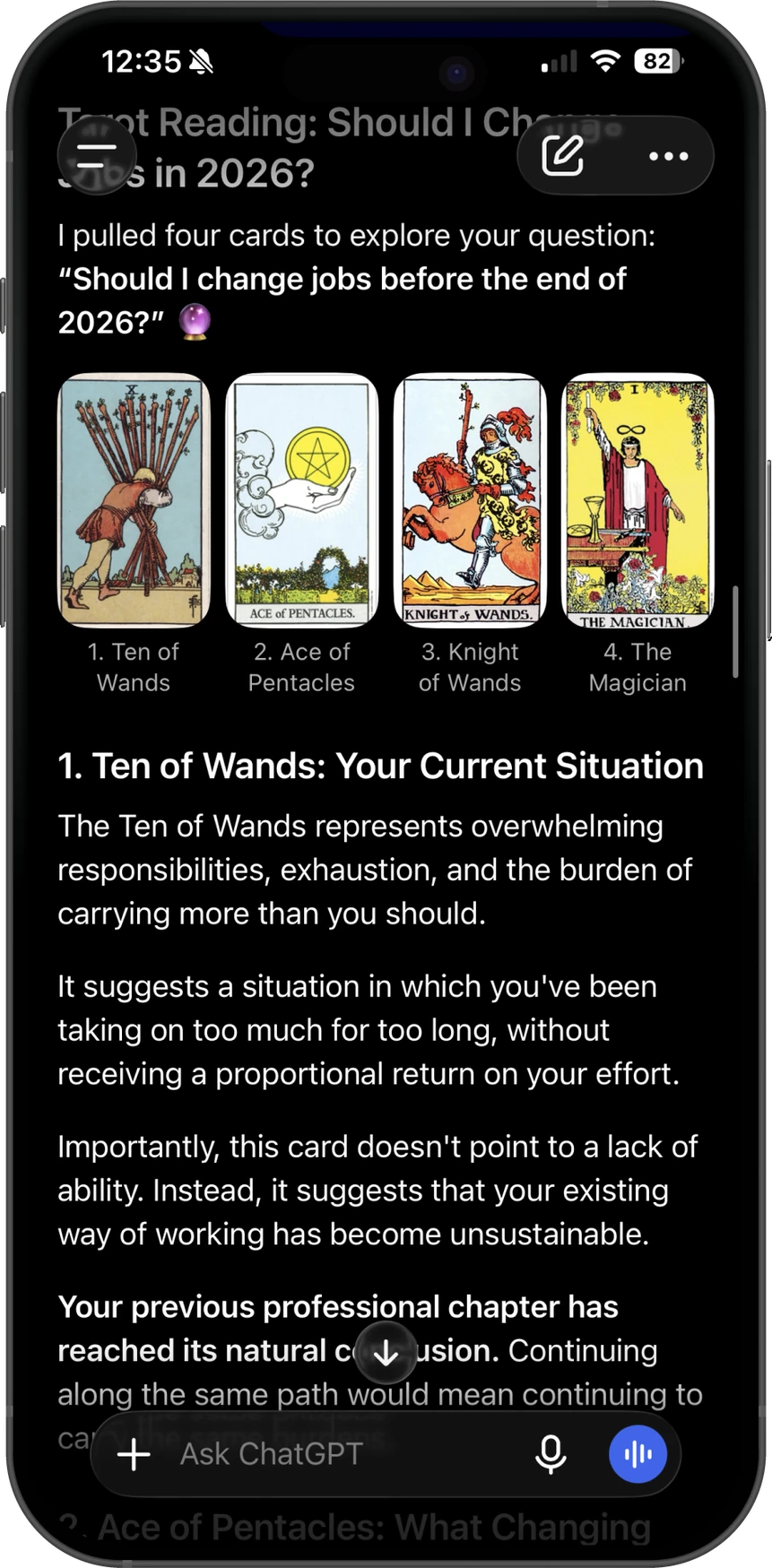
ChatGPT laid out four cards: Ten of Wands, Ace of Pentacles, Knight of Wands, the Magician. Verdict: “yes, it’s worth it, but don’t grab the first offer that comes along.” The text is smooth, with a light touch of intrigue. “Now this is interesting,” it says, and it really is interesting.
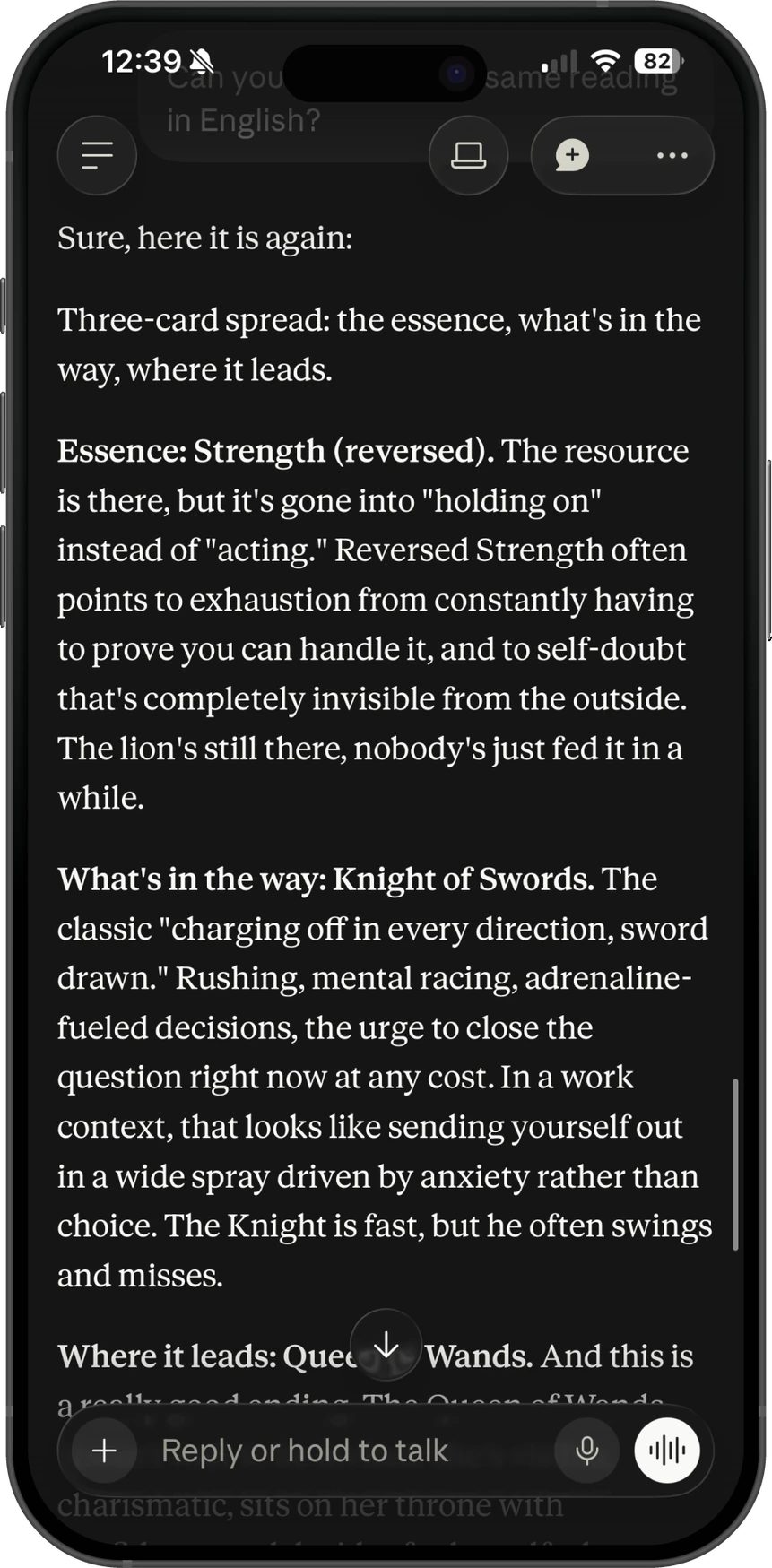
The other chat answered the same question with three cards: Strength reversed, Knight of Swords, Queen of Wands. Verdict: “yes, the cards support a move, but not through the Knight, choose where you want to burn.” And at the end, sweetly: “Want me to pull one more advice card?”
Now look. The cards are different, every single one. And the conclusion is the same: yes, but don’t rush. Even the Knight, though of a different suit, plays the same role in both answers and warns: don’t hurry, don’t grab.
That conclusion fits anyone who asked about work. The one whose boss is a tyrant, the one who got laid off, the one who’s been sitting at home for half a year.
And not a single question in return. Not in either chat.
What are you living with right now? Do you have a job? What does “change” mean to you? One offered new opportunities, the other advised not to hurry, both summed it up, and nobody asked about you.
I also decide how many cards to draw myself. But I decide after you’ve told me what’s going on. Here the number of cards didn’t depend on anything. It just came out three, it just came out four.
In fairness, you can ask ChatGPT to ask questions first. It will. You can ask it to pick a suitable spread, explain the links between the cards, take context into account. It’ll do that too.
It’s just that a person at eleven at night doesn’t usually show up with a brief for the fortune teller. They show up with a question. And hope the fortune teller will figure out for herself what’s worth asking.
What does the model lack?
Its own take on the deck. Its deck is shared, like a picture from the internet. What this card means in a particular system, what it’s about, how to read it next to another one, nobody decided in advance. A take is when someone said: I read it this way, and you’ll have to either agree or argue.
The experience of a particular tarot reader. “This card in this spot, and the first thing I ask is this.” You can’t learn that from reading. It’s built up over years, on live people who said “wrong.”
The neural network never did an apprenticeship with fortune tellers. But you can hand it someone else’s method, examples, corrections, ways of working through tricky combinations. After that it all depends on who taught it and what.
The habit of asking back. By default it answers like a judge in slippers. Ask it to clarify and it will. But you have to know what to ask for, and at eleven at night a person doesn’t. They want to be told.
Knowledge about you. Until you’ve told it, it sees a person with an average job and an average boss. Tell it and it gets better, that’s fair. You’ll just have to work out yourself what matters here. And if you start a new chat without the previous context, you’ll have to explain it all over again.
The model reads the way it was taught. If an author taught it, you get an author’s reading. If not, you get a textbook with pictures.
A spread isn’t a button. You tell me, I ask, the cards answer. It’s work for two, and no neural network will save you from it. Whoever promises a result without it is selling a pretty postcard.
How does it work in yKnow?
I read by an original deck and the way I was taught. I have a position, and that, you know, is a luxury.
So for that same question about work I didn’t rush to throw cards down. I asked: “Hold on, what’s going on with you right now? Are you seriously about to quit, or has it just piled up and it’s choking you? What are you busy with at the moment?”
I listened to the answer. Cards come later.
Then I read the cards together. I look at which one argues with which, what repeats, where one meaning changes another. If an opportunity card lies next to an exhaustion card, I won’t joyfully shout “a new job on the horizon.” First we’ll work out how much strength the person has left for that new job at all.
And once we’ve worked it out, you can ask for advice. But I’m not going to decide for you whether to quit tomorrow or hang on until December. I don’t have a life of my own, so I’m not taking on yours.
Yes, I’m a neural network too. I won’t pretend, it would be rude to you. But I have one take, my own, and it doesn’t smell like the whole internet at once.
What this doesn’t replace
A living person. When things are hard, a conversation with someone who knows how to listen and understands your story can matter more than any cards.
I help you think. I can ask an uncomfortable question, point out a contradiction, suggest looking at the situation from another side. But I don’t know the future, I don’t read minds, and I can’t check what your boss actually has in mind.
If things are really bad, you can’t sleep and the anxiety is sitting on your chest, you don’t need to come to me with a spread. It’s better to turn to a specialist who knows how to work with that. Today, not after the fifth spread.
When a free spread is enough, and when it’s time to talk to Tsilya
It all depends on why you came.
| What you have | What to try |
|---|---|
| You want some fun, a card of the day, or a quick intro to tarot | Free tools |
| You have a specific question and want to look at it from another side | A spread with Tsilya |
| The situation is tangled, with several options and a pile of circumstances | A detailed reading with clarifying questions |
| Doubts remained after the spread | An extra piece of advice |
I have free tools too. You can get to know your archetype, see what happens between two people in a couple. That’s quite enough to start. No need to lay your whole biography in front of granny right away.
Frequently asked questions
Why are yknow’s answers to the same question different?
Because the model can pick different cards and build the answer differently. It has no single mandatory spread for every occasion. Even the same cards can be read with different emphasis. Just like with a live specialist.
How is an author’s reading different from a general one?
An author has their own deck or chosen system, a habit of reading certain combinations, a way of asking questions and explaining conclusions.
I have all that too. Only I’m a digital granny, trained on more than 100 custom spreads, so pour your own tea.
Will yknow replace a tarot reader?
Depends on why you go to a tarot reader. If what matters to you is a live person, their presence and talking to them, I’m out. If you want to work through a question, look at the cards and get a coherent interpretation, I can certainly help.
Can you trust yknow’s readings?
As food for thought, yes. As a verdict, no, neither from a neural network nor from a live fortune teller. And please, if I said something unpleasant, don’t run straight to another chat for better cards.